


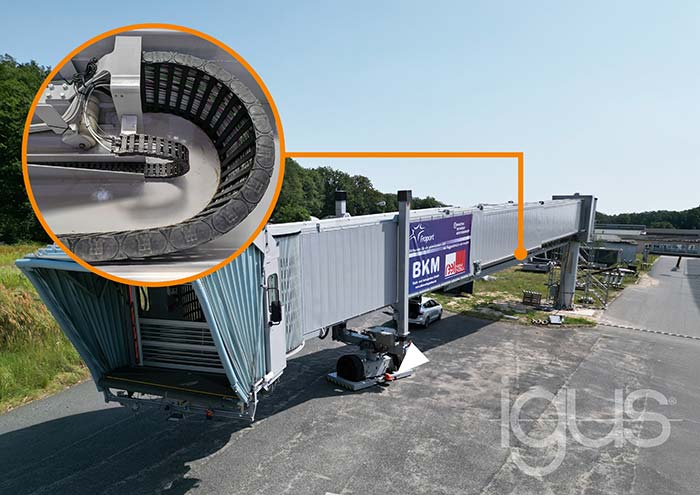
To ensure that the summer holidays get off to a smooth start: igus energy chains and cables ensure a high level of reliability in airport operations in REEL’s automated passenger boarding bridge. (Source: igus SE & Co. KG)
The train’s running late, the tickets have been left on the kitchen table, the child has forgotten its teddy: there are plenty of reasons for missing your flight. The factors at work behind the scenes of airport operations are less well-known: for example, automated passenger boarding bridges that transport passengers from the terminal to the aircraft. Here, a multitude of cables have to follow complex 3D movements whilst docking with the aircraft. A fault with one of the cables can delay the boarding process. To minimise this risk, the German company REEL relies on energy chains from igus.
REEL’s automated passenger boarding bridge has to move across several levels: it extends and retracts like a telescope, swivels, rises and lowers to reach different types of aircraft. This puts the numerous cables running inside the bridge – which, for example, supply sensors with power and data – to the test. If they were left exposed in the structure, they could rub against metal edges, become trapped between components or be damaged by repeated bending. “Airports expect maximum availability. The cable guidance is therefore one of the critical design aspects,” says Sven Helbig, Design Engineer at REEL. “We have therefore decided to use energy chains from the igus E4.42 series to guide the cables.”
Cable protection during complex 3D movements
The design engineers have assembled the energy chain vertically in an enclosed metal guide channel. It prevents the energy chain from shifting sideways and protects it from dirt, ice and foreign objects. During telescopic extension and retraction via three telescopic extensions with a total travel of 17.35m, one part of the e-chain moves with the moving bridge segment while the other remains attached to the fixed segment. An additional energy chain from the E4.21 series, which travels horizontally between the upper and lower runs of the stationary e-chain, houses the power and data cables for the central telescopic extension. At the end of the guide channel, the design engineers ultimately guided some cables into a second energy chain from the triflex series. It is responsible for height adjustment and can move along three dimensions.
“Thanks to this clever interplay between the energy chains, the cables are guided in a controlled manner throughout the entire movement and protected against mechanical loads such as chafing, jamming and excessive bending. This reduces the risk of cable faults and improves the operational reliability of the passenger boarding bridge,” explains Markus Marienfeld, Technical Sales Consultant at igus, who is supporting the project.
Suitable for harsh airport operations
It wasn’t just the sequence of movements that the designers at REEL had to consider when developing the cable guide. Another challenge was the fact that passenger boarding bridges are exposed to changing environmental conditions outdoors all year round: heat, frost, rain and UV radiation. Added to this are aggressive chemicals such as cleaning agents, de-icing fluids and kerosene. “These loads can cause cables and guides to age prematurely, and plastics to become brittle or swell. This can adversely affect the operational reliability of the system,” says Helbig. “igus’s energy chains are made from high-performance plastics that are designed for long-term use in these demanding environmental conditions. This helps ensure high system availability and long maintenance intervals.”
Reliability due to optimised system technology
One of the main challenges the design engineers had to meet was to find suitable power and data cables that could withstand the movements, long travels and harsh environmental conditions associated with airport operations. “If we had combined energy chains and cables from different manufacturers, it would have required a great deal of coordination,” said Helbig. “We were therefore delighted that igus now offers over 1,350 cable types from the chainflex range, which have been specially developed for use in energy chains.”
The cables and energy chains are a perfect match in terms of bend radius, dynamic performance and service life, and are designed as an integrated system to ensure long-term, reliable operation. For added peace of mind, the plastics specialist offers a guarantee of up to four years on its products, based on an igus service life calculation. “This way, energy chains and cables play a vital role behind the scenes in ensuring that our passenger boarding bridge operates reliably and that summer holidays don’t get off to a delayed start right at the gate,” explains Helbig.