


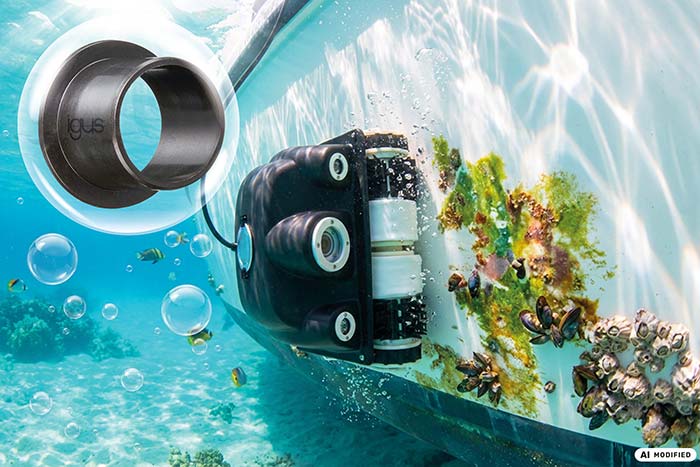
For clean boat hulls: The KeelCrab underwater robot uses lubrication-free polymer bearings from igus for low-maintenance and corrosion-free operation in salt water. (Source: igus SE & Co. KG)
It is every boat owner’s nightmare: algae, mussels and barnacles that have to be removed from the hull before every season. In future, a remote-controlled diving robot named KeelCrab by the Italian company Aeffe will make the stowaways easier to remove. However, for the little crawler to work permanently underwater, the developers had to solve a challenge with the drive. The bearing of the drive rollers with lubrication-free polymer plain bearings from igus plays a key role.
At first glance, everything seems very simple: The owner launches the KeelCrab into the water. With a joystick and camera, he moves the robot across the boat hull, while two brushes remove deposits. But the design was not quite so simple after all. Keyword: locomotion underwater and overhead. The designers had to develop a drive suitable for underwater use. They opted for a vacuum pump, with which the robot sucks itself onto the hull, and two caterpillar tracks. “The bearing of the four drive rollers was a real problem here,” recalls Mattia Pagani, development engineer at Aeffe. “For underwater use, we were looking for a solution that was as fail-safe and low-maintenance as possible and, at the same time, did not increase the weight of the robot too much.” The developers finally found a solution for the bearing of the four drive rollers in plain bearings made of the high-performance polymer iglidur X from igus.
Fail-safe bearings for underwater use
A deployment underwater is a challenge for many conventional bearings. “Classic lubricated rolling bearings were out of the question because of the risk of corrosion,” explains Mattia Pagani. However, the high-performance polymer of the igus plain bearings is corrosion-free. Another advantage: Unlike many standard plastics, iglidur X absorbs very little moisture. The bearings remain dimensionally stable, even in continuous contact with fresh or salt water. “This is a major challenge for the permanently reliable underwater use of our robot.”
Lightweight and economical
However, the risk of corrosion was not the only factor in the selection of plain bearings for the robot’s drive. The designers also attached importance to lightweight construction and low operating costs. “We briefly considered single-row radial bearings made of stainless Ionox steel with seals, but these would have been too heavy and too expensive,” says Mattia Pagani. “The polymer bearings from igus weigh around 80% less than comparable metal bearings due to their low material density.” At the same time, thanks to integrated solid lubricants, they work permanently dry. There is no need for lubricants or the associated maintenance work. “This reduces the operating costs over the entire service life, an advantage that ultimately benefits the robot operators as well.”